
Audio vs. Video Podcasting: Which Format Is Right for You?
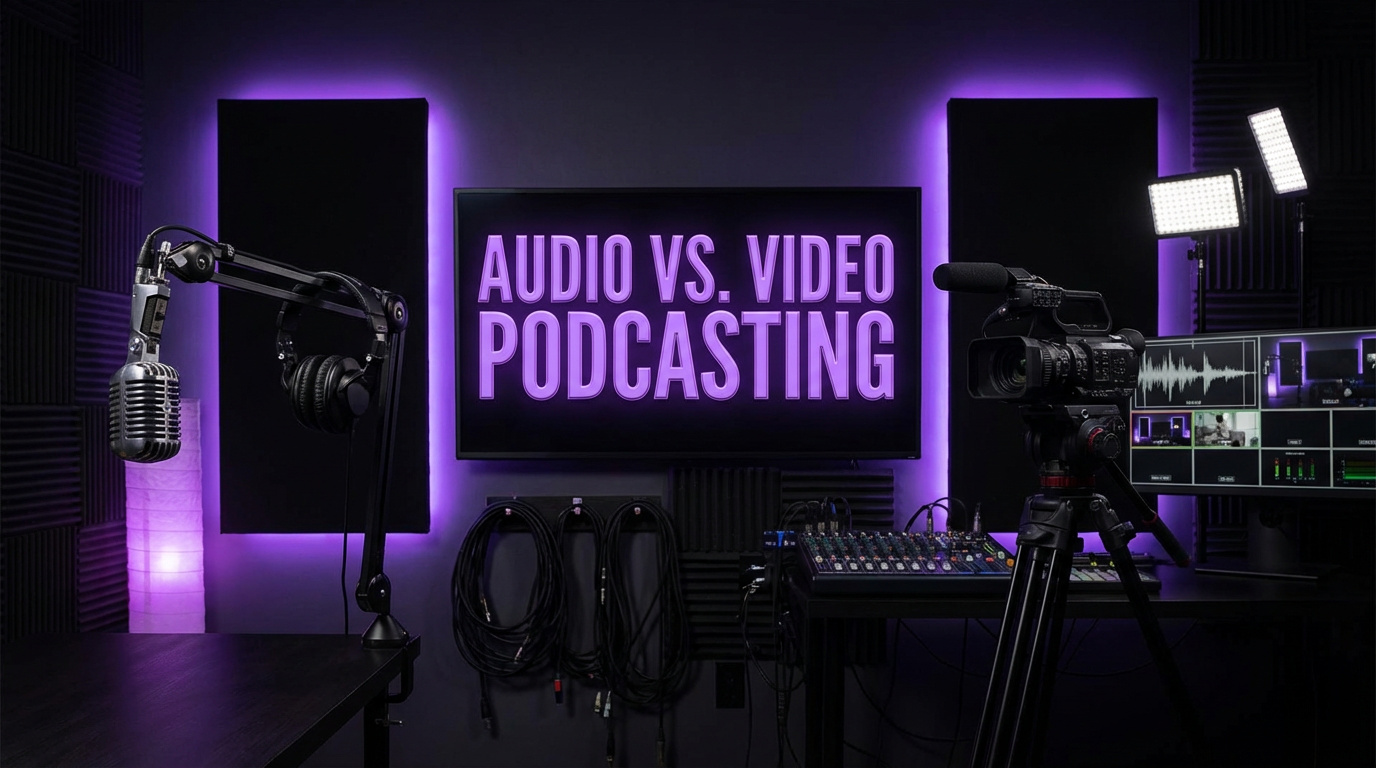
Picture two podcasters. Both have sharp ideas, genuine expertise, and real enthusiasm for their topics. One records a clean, well-produced audio episode, uploads it, and moves on. The other sets up cameras, adjusts lighting, records the same conversation on video, edits both versions, and distributes across multiple platforms.
Six months later, both shows have grown. But they grew differently, reached different audiences, and required completely different workflows to sustain.
This is the reality of the audio versus video podcasting decision. Neither format is universally better. Both are legitimate, powerful ways to build an audience and deliver value. But they are not interchangeable, and choosing between them without thinking it through carefully can mean building a workflow you cannot sustain or missing the audience that was right in front of you.
This guide breaks down everything you need to know to make the right call for your show, your goals, and your life.
Understanding the Core Difference Between Audio and Video Podcasting
Before getting into the tactical considerations, it helps to be clear about what each format actually is and how audiences experience it.
Audio podcasting is the original format. Listeners consume it through platforms like Spotify, Apple Podcasts, and Amazon Music, typically while doing something else. Commuting, exercising, cooking, cleaning. Audio is a companion medium. It fits into the gaps of daily life in a way that video simply cannot, because video demands your eyes.
Video podcasting layers a visual dimension on top of the audio experience. It is distributed primarily through YouTube, but increasingly through Spotify's video podcast feature and other platforms. Viewers watch and listen, often in a more intentional, seated context. The experience is closer to watching a show than listening to one.
These are not just technical distinctions. They represent fundamentally different relationships between creator and audience, and they shape everything from how you prepare your content to how your audience discovers and shares it.
The Case for Audio Podcasting
Lower Production Barrier to Entry
Audio podcasting is more accessible than video podcasting in almost every practical sense. The equipment required is simpler, the setup is faster, the recording process is more forgiving, and the editing workflow is considerably less time-intensive.
A solid USB microphone, a treated recording space, and basic editing software are enough to produce a professional-quality audio podcast. You do not need to think about camera angles, lighting setups, background aesthetics, or what you are wearing. You show up, you speak, you record.
For solo creators, small teams, or anyone with limited time, this lower barrier is genuinely significant. It means you can focus your energy on what matters most, which is the content itself.
Audio Fits Into Your Listener's Life
The portability of audio is one of its most powerful and underappreciated advantages. When someone listens to your podcast during their morning run or their commute, they are spending time with your voice in a deeply personal, distraction-free context. There is no feed to scroll, no notifications competing for attention. It is just you and them.
This intimacy builds a particular kind of loyalty. Audio podcast listeners who find a show they love tend to stick with it. Completion rates for audio episodes are consistently high, which means your message is actually getting through rather than being skimmed or dropped halfway.
Distribution Reach Across Established Platforms
Audio podcasting has a mature, well-established distribution ecosystem. Apple Podcasts, Spotify, Amazon Music, Pocket Casts, Overcast, and dozens of other platforms are actively used by hundreds of millions of people who are specifically looking for audio content to consume. Getting your show in front of these audiences is relatively straightforward through RSS distribution.
The discoverability mechanisms within these platforms, while imperfect, are specifically designed for podcast content and reward consistent, quality publishing in ways that can meaningfully accelerate your show's growth.
Ideal for Thought Leadership and Niche Authority
If your goal is to establish authority in a specific niche, audio podcasting is an exceptionally effective vehicle. The format rewards depth and nuance in a way that short-form content cannot. A 45-minute audio conversation that goes deep on a topic positions the host as a serious, knowledgeable voice in their field.
For professionals, consultants, coaches, and subject matter experts building a personal brand or attracting clients, a well-produced audio podcast delivers a level of trust and authority that other content formats struggle to match.
If you are leaning toward audio and want to ensure your production quality matches the expertise you are bringing to the mic, the audio production services at Fox Talkx Studio are designed to help you sound as credible as you are.
The Case for Video Podcasting
YouTube Is the World's Second Largest Search Engine
This single fact changes the calculus for many podcasters. YouTube has over two billion logged-in monthly users and functions as a search engine as much as a video platform. When someone searches for information, education, or entertainment in your niche, YouTube results appear alongside Google results. Audio podcasts, no matter how good they are, are largely invisible to this search behavior.
A video podcast creates a permanent, searchable, discoverable asset that can continue attracting new viewers for months or years after it is published. A single well-titled video podcast episode can drive consistent organic traffic to your show in a way that audio-only distribution generally cannot.
For podcasters who are serious about growing their audience beyond their existing network, YouTube's discoverability is a compelling reason to invest in video.
Visual Context Adds a Layer of Connection
There is something that happens when an audience can see you that goes beyond what audio alone can deliver. Your facial expressions, your body language, the way you react when a guest says something unexpected, the visual dynamic between two co-hosts who genuinely like each other -- these are signals of authenticity and personality that audio cannot transmit.
Video builds parasocial connection faster. Audiences feel like they know video hosts more quickly because they have seen them, not just heard them. In a landscape where audience loyalty is built on trust and familiarity, that accelerated connection has real value.
Repurposing Potential Is Significantly Higher
A video podcast episode is a content production engine. From a single recorded session, you can extract the full video for YouTube, the audio for traditional podcast platforms, short clips for Instagram Reels, TikTok, and YouTube Shorts, quote graphics for Twitter and LinkedIn, and written content derived from a transcript.
This repurposing potential makes video podcasting a highly efficient content strategy for creators and brands who need to maintain a presence across multiple platforms. One recording session, done well, can fuel a week or more of content across channels.
For brands especially, this multiplier effect makes the additional production investment in video podcasting easier to justify. The full-service production support at Fox Talkx Studio is built to help podcasters capture and maximize that repurposing potential from every session.
Growing Platform Support for Video Podcasting
Spotify has made significant investments in video podcast infrastructure and is actively promoting video content within its platform. This means that video podcasts are increasingly accessible to audiences who are already in podcast-consumption mode, not just to YouTube viewers.
As the lines between podcast platforms and video platforms continue to blur, the distribution advantages of audio-only podcasting are gradually narrowing. Video podcasters who establish themselves now are positioning their shows for a landscape where video is the expected standard, not the exception.
Where Audio and Video Podcasting Get Complicated
The Production Time Gap Is Real
The honest reality of video podcasting is that it takes significantly more time and effort per episode than audio. Recording setup takes longer. The footage has to be reviewed and edited differently from audio. Thumbnail creation, video SEO, caption work, and platform-specific optimization add meaningful time to your publishing workflow.
For solo creators without production support, the jump from audio to video can easily double or triple the time investment per episode. That is a real cost that has to be weighed honestly against the benefits.
If you are already stretched thin with your current audio workflow, adding video without additional support or infrastructure could lead to burnout, inconsistency, or a drop in content quality that undermines the very growth you were hoping to accelerate.
Audio Quality Still Matters Just as Much in Video
A common mistake new video podcasters make is investing heavily in cameras and lighting while underinvesting in audio. The result is a show that looks professional but sounds mediocre, which is arguably worse than either format done consistently.
Research on viewer behavior consistently shows that audiences will tolerate imperfect video quality far longer than they will tolerate poor audio. Bad audio in a video podcast is an immediate exit trigger. It signals low production values and makes the content feel effortful to consume.
If you move into video podcasting, your audio setup needs to be at least as good as it would be for a standalone audio podcast. The visual dimension adds to the experience; it does not replace the need for clean, broadcast-quality sound.
Not Every Show Benefits Equally from Video
Some podcast formats translate beautifully to video. In-person interviews, panel discussions, co-hosted shows with strong on-screen chemistry, and educational content with visual demonstrations are natural fits for video.
Other formats are less naturally suited. Narrative story-driven podcasts, highly produced audio documentaries, and solo shows where the host is reading from a script can feel flat or awkward on camera. The format that makes the audio version compelling does not always translate visually.
Before committing to video, honestly assess whether your specific format and content style will benefit from a visual layer or whether it might actually work against the experience you are trying to create.
Key Questions to Ask Before Choosing Your Format
What Are Your Actual Growth Goals?
If your primary goal is building a broad, discovery-driven audience as quickly as possible, video gives you access to YouTube's search and recommendation ecosystem, which is one of the most powerful organic growth engines available to content creators. If your goal is deep engagement with a niche audience and consistent listenership from a loyal community, audio can serve that goal extremely well with far less production overhead.
Be honest about what you are actually trying to build, not what sounds most impressive.
What Can You Realistically Sustain?
Consistency is the single most important factor in podcast growth over time. A format you can publish on a reliable schedule will always outperform a more ambitious format that leads to burnout and irregular releases.
Before choosing video, map out exactly what your weekly or biweekly production workflow would look like. Account for recording, editing, thumbnail creation, upload, and promotion. If that workflow is not genuinely sustainable with your current time and resources, start with audio and add video when the infrastructure to support it is in place.
Do You Have or Can You Access the Right Equipment?
Audio podcasting requires a good microphone, headphones, and recording software. Video podcasting requires all of that plus at least one quality camera, proper lighting, a visually intentional background, and video editing software.
The gap in equipment cost and complexity is meaningful, particularly for independent creators. If the equipment investment for video is not accessible right now, that is a legitimate reason to start with audio and build toward video as your show generates revenue or attracts sponsorship.
Where Does Your Target Audience Already Spend Time?
Research where people in your specific niche are already consuming content. Are they primarily podcast listeners who follow shows on Spotify and Apple Podcasts? Are they YouTube users who watch long-form video content? Are they active on both?
The format that puts your show in front of the audience you are trying to reach is more important than the format that is theoretically superior in the abstract. Audience behavior in your specific niche should inform this decision significantly.
If you are working through these questions and want experienced input on which format makes the most sense for your specific show concept and goals, the team at Fox Talkx Studio can help you think through the decision and set up the right production framework from the start.
Can You Do Both? The Hybrid Approach Explained
Many podcasters eventually arrive at a hybrid model where they record video and distribute both video and audio versions of the same episode. This approach captures the discoverability benefits of YouTube while maintaining presence on traditional podcast platforms.
The hybrid model works well when the additional production burden is manageable, either because the show has a team supporting it, because the host has invested in a streamlined workflow, or because they are recording in a professional studio where video capture is built into the session rather than added on top of it.
If you are considering the hybrid approach, the key is to ensure that the video version is genuinely good rather than being an afterthought. A poorly lit, static single-camera setup slapped onto an audio podcast session is unlikely to perform well on YouTube. If you are going to distribute video, the visual production needs to be intentional and polished.
Starting with audio and adding video once your show has found its voice and its audience is a sensible path for many creators. It allows you to develop your content and hosting skills without the additional complexity of video production, and then layer in the visual dimension when you have a clearer sense of what your show looks and feels like.
Wrapping Up: There Is No Wrong Answer, Only the Right Fit
The audio versus video debate does not have a universal winner. It has a right answer for your specific situation, and that answer depends on your goals, your resources, your content style, and the audience you are trying to reach.
Audio podcasting offers accessibility, intimacy, and a proven distribution ecosystem. Video podcasting offers discoverability, visual connection, and powerful content repurposing potential. Both can build loyal audiences. Both can support serious business and creative goals. Both require consistent, quality execution to deliver results.
What matters most is choosing the format you can commit to fully and then executing it with genuine care and professionalism. A mediocre video podcast does not outperform a great audio podcast just because it has a visual component. Quality and consistency win in every format.
If you are ready to launch or grow your podcast and want a production partner who can support you in either format or both, Fox Talkx Studio has the equipment, the expertise, and the experience to help you build a show that sounds and looks exactly the way you want it to.
The format question is just the beginning. The work, and the reward, comes after you decide.